A team of researchers from the International Center MagTop, Institute of Physics PAN (Warsaw), in collaboration with the theorist from the Warsaw University of Technology and the researchers from URANOS beamline team at the SOLARIS Synchrotron Facility (Cracow), has published an interesting study on the electronic properties of the topological nodal-line semimetal ZrAs2. The article, titled “Emergent Impervious Band Crossing in the Bulk of the Topological Nodal-Line Semimetal ZrAs2”, has appeared in Physical Review B. This research offers fresh insights into the complex electronic structure of ZrAs2 achieved by employing a sophisticated combination of angle-resolved photoemission spectroscopy (ARPES) and density functional theory (DFT) calculations.
The SOLARIS team, in cooperation with the AGH University of Science and Technology's Centre of Excellence in Artificial Intelligence, published the results of research on the automatic analysis and classification of Pinhole diagnostic line transverse beam profiles.
A team composed of scientists from the National Synchrotron Radiation Centre SOLARIS, the Institute of Physics of the Jagiellonian University, the Institute of Nuclear Physics of the Polish Academy of Sciences (PAN), and the Institute of Low Temperature and Structure Research of the Polish Academy of Sciences (PAN), has published the results of their research on the superconducting compound LaCuSb2. The experiment was conducted using the URANOS beamline at the SOLARIS synchrotron.
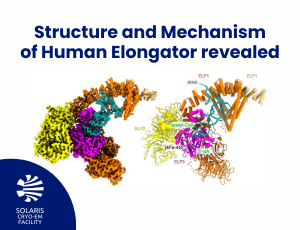
Protein synthesis is heavily affected by the presence of various modifications in tRNAs. Wobble uridines in the anticodon stem loop are modified by a large cellular machine called Elongator. Genomic mutations in this macromolecular complex lead to the onset of severe human diseases. The latest work of scientists from the Malopolska Centre of Biotechnology (MCB) of the Jagiellonian University describes the first high-resolution cryo-electron microscopy (cryo-EM) structures of human Elongator and its mechanism of action. The study was published recently in Nature Communications.
A research team under the leadership of Sebastian Molin D.Sc., from the Faculty of Electronics, Telecommunications and Informatics at Gdańsk University of Technology (as part of a joint project with scientists from the Warsaw University of Technology and Kaunas University of Technology), in collaboration with ASTRA beamline scientists, characterised the perovskite oxide La0.6Sr)0.4CoO3-δ as an oxygen electrode for solid oxide fuel cell technology. This material showed enhanced electrochemical efficiency for the reduction of oxygen when present in a partially amorphous form. Using X-ray absorption spectroscopy (XAS) at the SOLARIS synchrotron. The results of the study have been published in the journal of Applied Surface Science, published by Elsevier.