
The Ultra Resolved ANgular phOtoelectron Spectroscopy beamline (URANOS) is an experimental installation for studies of the electronic structure of solid surfaces by Angle and Spin-Resolved PhotoElectron Spectroscopy (ARPES & Spin-ARPES) technique in the range from 8 to 170 eV with any selectable polarization. The beamline is designed for high photon flux, high resolution, variable polarization, and minimal harmonic contamination.
The ARPES technique has an extremely important place among methods of studying the structure of matter because it allows the measurement of fundamental parameters for electrons: energy, momentum and spin. Direct measurement of these parameters is performed for photoelectrons in a vacuum above the surface of the sample. Within the so-called sudden approximation, these parameters can be related to the binding energy and momentum of the electron in the sample prior to the photoelectric excitation.
Due to this technique, it is possible to study the band structure quickly and thoroughly in multidimensions (kx, ky, kz, σx, σy, σz, E) including the effects of electron correlations, electron-phonon, electron-dopant interactions. In other words, this technique provides a direct measurement of the multidimensional dispersion relation E(k, σ) in solids.
In addition, the URANOS beamline enables X-ray Photoelectron Spectroscopy (XPS) measurements up to 500 eV, X-ray photoelectron spectroscopy techniques with extreme surface and angular sensitivity (SXPS, SX-ARPES, GI/TR-XPS) and studies of the crystallographic structure of the surface by low energy electron diffraction (LEED) are also possible.
Experimental techniques:
- ARPES (Angle-resolved photoelectron spectroscopy),
- Spin-ARPES (Spin- and Angle-resolved photoelectron spectroscopy,
- CD-ARPES (Circular Dichroism ARPES),
- RES-ARPES (RESonant ARPES),
- S-XPS (Soft X-ray Photoelectron Spectroscopy),
- GI/TR-XPS (Grazing Incidence/Total Reflection XPS),
- (MCP- LEED) Low energy electron diffraction with minimal exposure (MCP detector).
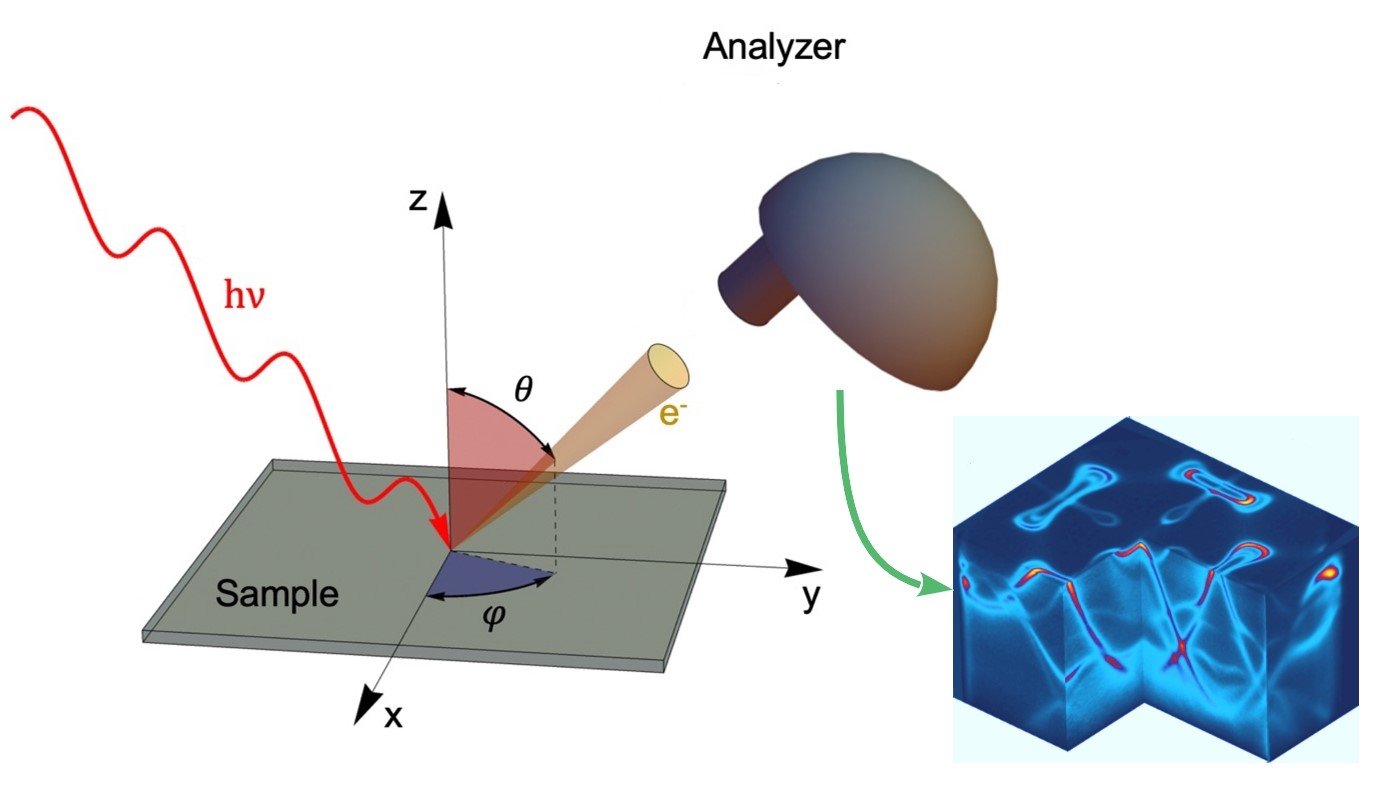
Figure 1. ARPES measurement scheme.

Figure 2. Geometry and scheme of ARPES and Spin-ARPES measurements.
The most important features of the URANOS beamline are as follows:
- automatic measurements of the multidimensional dispersion relation E(k, σ) with ultra-high energy, angular and spin resolution and at very low temperatures (<<10K),
- spectrally pure (contamination of higher harmonics <1%), monochromatic photon beam with a wide range of energy and any polarization,
- extensive possibilities of in situ sample preparation.

Figure 3. Band structure of a NbP Weyl semimetal measured at an excitation energy of 92 eV with visible Fermi arcs. Link.
Beamline parameters
| Parameters | Value |
|---|---|
| Source | Elliptically polarizing undulator (EPU) type APPLE II, quasi-periodic. Magnetic structure period: 120mm. |
| Available energy range | Total: 8–500 eV NIM: 8 eV–30 eV PGM: 14 eV–500 eV |
| Energy resolution ΔE/E | 5x10⁻⁵ |
| Beam size at the sample (H x V) | 150 μm x 60 μm / 60 μm x 60 μm (with a limited photon flux) |
| Photon flux at sample | >5 x 10¹¹ fotons/s @ 20 000 RP (RP = E/∆E) |
| Polarization | Any, selectable: Linear Horizontal, Linear Vertical, Circular Left, Circular Right, Ellipticals, Linear Skews |
|
End station URANOS- ARPES -SpinARPES |
Available methods: (High resolution) angle- and spin-resolved photoelectron spectroscopy - (HR)-Spin-ARPES, |
| Analisis chamber |
Hemispheric Energy Analyzer DA30L with deflectors (Scienta) 3D VLEED Ferrum Spin detectors (Ferrum-Scienta Omicron) 6-axis cryogenic manipulator (Prevac) Diffractometer OCI LEED 800 MCP I(V) |
| Detector resolution | Energy: 1.8 meV, angular: 0.1° |
| Temperature range | 4 – 500 K on 6 – axis manipulator |
| Samples storage | 24 |
| Preparation chamber |
Low-Energy Electron Diffraction (Mini-LEED), Residual Gas Analyzer (RGA), Quartz Micro Balance (QMB), Ion Bombarded and Annealed (IBA), RESistance heater (RES), Electron Beam heater (EB), pyrometer |
| Preparation temperature | 150 – 2000 K (RESistance heating (RES) up to 800°C, EB – direct heating up to 1700°C) |
| Installation of user devices | 3 ports for connecting user devices and 1 port for the vacuum case |
| Introductory chamber | 6 - positional carousel |
| Sample preparation |
|
Experiment support from the local contact person is available:
- during standard working hours on weekdays, from 8:00 AM to 5:00 PM;
- on-call by phone on weekdays, from 5:00 PM to 10:00 PM;
- on-call by phone on Saturdays and Sundays, from 9:00 AM to 5:00 PM.
Other rules regarding experiment implementation are described in the user guide.
The rules for working on the URANOS beamline are described in the document below. Users are required to familiarize themselves with these requirements and rules before starting their experiment.