News - Narodowe Centrum Promieniowania Synchrotronowego SOLARIS
SOLARIS centre
Modern porous materials in the service of the environment
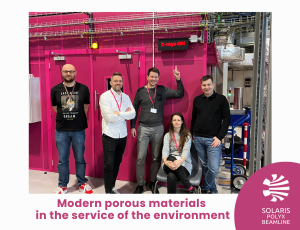
A team of scientists from Europe and Asia – Prof. Miroslav Almasi and Dr Milica Zelinska from the Department of Inorganic Chemistry at Pavol Jozef Šafárik University in Košice (Slovak Republic), Dr Tomas Zelenka from the Department of Chemistry at the University of Ostrava (Czech Republic), and Dr Branislav Viliam Hakala from the School of Environmental Science and Technology at Dalian University of Technology (China) – is conducting research on innovative porous materials such as metal-organic frameworks (MOFs), porous oxides, and graphitic carbon nitrides (GCNs). Their joint work focuses on the application of these materials in gas adsorption, wastewater treatment, catalysis, energy storage, and biomedical applications. It was precisely the need to apply advanced structural analysis methods to these materials that brought the team to the SOLARIS Centre.
A key element of the collaboration between Prof. Almasi and Dr Zelenka is the development of MOF@HPCM composites – materials combining MOFs with hierarchically porous carbon monoliths. They worked on these during their joint stay at the POLYX beamline at the SOLARIS Centre. The group’s research aims to develop innovative materials for environmental applications. MOF@HPCM composites are used for carbon dioxide capture, supporting efforts to reduce greenhouse gas emissions. The team is also exploring ways to improve hydrogen storage capacity by incorporating metal nanoparticles into the composite structure, contributing to the advancement of clean energy technologies. Additionally, the group is working on the removal of toxic metal ions and organic pollutants from wastewater, which directly contributes to improving water quality. This research supports the objectives of the European Green Deal, particularly by promoting CO₂ emission reduction and the implementation of sustainable energy storage technologies that may play a key role in achieving climate neutrality by 2050.
The choice of the SOLARIS Centre as the research site was driven by the need to employ advanced structural analysis techniques not available in standard laboratories.
-Thanks to the capabilities of the POLYX beamline, we were able to perform non-invasive, three-dimensional analysis of the internal structure of the materials using X-ray computed tomography (µCT), as well as investigate the spatial distribution of elements with X-ray microfluorescence (µXRF). These techniques provided unique insight into the distribution of MOFs within the carbon monoliths, which is crucial for their functionality in environmental and energy applications" said Prof. Miroslav Almasi, coordinator of the group.
- At the same time, we would like to express our gratitude to the POLYX beamline staff for their invaluable assistance, kindness, and professional technical support, which enabled the smooth and efficient execution of all experiments - added Prof. Almasi
Authors: Prof. Miroslav Almasi, Team of the POLYX beamline, Dagmara Chylewska-Olech
Author of the photos: Joanna Kowalik
Published date 04/07/2025
-
Dagmara Chylewska-Olech
Recommended